

Conservation on the Big Screen
Rating Conservation Portrayals in Film
Hollywood has enjoyed portraying museums and museum professionals for decades. It allows for fantastic heist films like How to Steal a Million and romantic settings for both romantic comedy and art films like Manhattan and When in Rome. However, like everything in Hollywood, it is glamorised and not entirely accurate.
Knowing this, I was curious about how many films had a conservator as a main character, and how accurate their depiction may be. So, I’ve decided to go through films that present conservation, and consider their accuracy. In order to narrow this list down, I am only considering English-language full-length feature films that demonstrate at least one on-screen conservation scene. This, of course, precludes any documentaries and passing mentions of conservation.
Scream of the Banshee: 1/10
Available on Tubi (free with ads)

At a university, archaeology professor Maura Whelan (Lauren Holly) is working late with several students on an artefact cataloguing project (where she also seems to perform some active conservation treatment). Part of this project is a mysterious box containing an Irish gauntlet and a hand-drawn map of “section 3”, a storage area rarely used. One of the students uncovers a small room hidden behind a false wall in the section. Inside is a crate; inside the crate is the magic box/shield containing the head of a banshee. The banshee’s head screams, and over the course of the night, Whelan and her students are haunted by the spirit.
I am not sure what I was expecting; after all, it is a SyFy original (although Sharknado does hold a special place in my heart). But to be honest, this movie just doesn’t make sense, from both a conservation/museological side as well as just the basic plot itself. Whilst the evil artefact trope is fun, this movie does not do it well.
The one good thing about this movie is that Professor Whelan does use nitrile gloves whilst handling the object and whatever adhesive she is using on the object. She also keeps all of her solvents in dark bottles to limit deterioration.
However, that is the only good thing about the treatment scene that introduces the main character. Whelan works in an extremely cluttered classroom on an average desk. She applies whatever adhesive or solvent to a very ornate decorative arts vase, utilising a very awkward and large dropper, straight from the large bottle. Another thought I had whilst watching this part was that she was doing all of this without a fume hood or trunk, which must make her very dizzy (and hallucinate a banshee, perhaps). I also disapprove of her use of bubble wrap for the vase following treatment, and the fact that she wraps it so quickly after the solvent/adhesive was applied, allowing no time for evaporation or curing. If you ask any collections manager, registrar, or conservator, you’ll find out that we hate bubble wrap. It is not nearly as effective as a soft foam and can provide uneven pressure on fragile objects. Glazed ceramics are especially at risk, where uneven pressure can cause damage to the glaze surfaces. Following this, she announces to her camcorder that the “restoration [is] complete” before placing the box at a very precarious angle on the edge of her desk. She then takes it to the “archival storage” of the university by tucking the box under her arm. This is such a recipe for a disaster, especially with the false jump scare that occurs in the hall, one of the many reasons you should always use a cart to transport objects.
In the archive, things get worse. No one in the archive uses gloves when handling objects. This is especially heinous regarding an old coin and the Irish gauntlet (which one of the students puts on, and at that point, I think he deserves to be cursed). Metal objects should always be handled with gloves, as the oils in our hands can etch the surfaces and accelerate deterioration.
In “section 3”, there is noticeable damp and condensation, leading to a gross mould that covers the entrance to the secret room. No one appears concerned with the sodden boxes of objects/archives that could be damaged, or the very real health and safety risk presented by inhaling mould spores.
I’m convinced this whole film is a fever dream caused by solvent fumes and mould inhalation. It’s terrible, both in its plot and its depiction of conservation.
Head Over Heels (2001): 2/10
Available on YouTube (free with ads)

Amanda Pierce (Monica Potter) is a paintings conservator in New York who, after finding her partner cheating on her, moves into an apartment with several supermodels. She falls in love with Jim Winston (Freddie Prinze Jr.), who lives across from them. However, one night she witnesses him appear to murder a woman, and becomes determined to figure out what is going on.
On the positive side, several scenes take place in Pierce’s underground paintings conservation space (definitely not deserving of the title of laboratory). She is seen in this space wearing not only gloves (albeit cotton ones) but also a lab coat, and uses an Optivisor for careful varnish removal using swabs.
But, unfortunately, this movie is wild. Her PPE does not make up for the amount of concern I have regarding this conservator and her space. I think the most concerning part is the amount of food and drink allowed into the space. There is a scene where Pierce is eating a sandwich at her easel, notably eating with the gloves she was wearing still on. This would arguably cause great concern for contamination. Similarly, there is another scene where she is offered a coffee and proceeds to drink it OVER a piece of art. This is obviously not even remotely close to best practice and is a great cause for concern over the safety of art in this woman’s care.
From an ethical standpoint, I also struggle to come to terms with Pierce’s decision to paint a completely new face onto the piece she is working on. This, of course, adds to the “romance” of the film, as she decides to paint Winston in after she determines that he has “perfect Renaissance features”. Whilst I am not a paintings conservator, I am fairly certain there is far more research, analysis, and discussion that should be performed prior to deciding whether a painting should be retouched, and I am fairly certain people would not be okay with the conservator taking such a great liberty with the decision.

If you like slapstick comedy with little sense, you may enjoy this movie, but don’t go into it thinking that this is remotely how paintings conservation works.
Made of Honor: 3/10
Available through Netflix

A disclaimer that Made of Honor is one of my favourite romcoms. But even that does not save this movie from my conservator scrutiny.
Tom (Patrick Dempsey) and Hannah (Michelle Monaghan) have been platonic friends for ten years. He’s a serial dater, while she wants marriage but hasn’t found Mr Right. Just as Tom is starting to think that he is relationship material after all, Hannah gets engaged. When she asks Tom to be her “maid” of honour, he reluctantly agrees just so he can attempt to stop the wedding and woo her.
When we’re introduced to Hannah after the flashback opening scene, she’s working as a paintings conservator at the MET. She’s working on removing the varnish from a panel painting using swabs with an optivisor perched on her forehead. But that’s about as much as I can give this movie credit for.
Tom walks in to find her working and offers her a cup of coffee, which she drinks whilst working. This will never not bother me. Stop having people eat and drink next to art. There’s a reason that most museums and galleries have “no food or drink” policies.
The main plot hinges on a trip Hannah takes to Scotland for an “acquisitions trip”. The whole setup is vague. She suggests she is the one trying to get the board of this “ancestral home” to sign off on the acquisitions when the trip is already planned. They also allot SIX WEEKS for this trip. I know the MET has money, but is that really what they’re spending it on? It feels like a waste. They also apparently fly her out there in business/first class.
I could let a lot of this go. Condition surveys and courier trips are relatively normal in the museum world, even if Hollywood doesn’t really understand the ins and outs of them. But when Hannah returns from her trip is where I really start losing faith in her as any kind of museum professional, much less a conservator. But when Hannah comes back to New York to announce her engagement, she explains that they “just spent the next month travelling around the country, going to museums, ya know?” So wait. Did she just forget about the acquisitions for the MET? Did she crate them and then wash her hands of the whole situation? I have so many questions, and none are answered! Hannah just drops her career entirely, and it’s not mentioned the rest of the movie. I need answers.
Home for the Holidays (1995): 4/10
Available through Hoopla (free with most US library cards)

The film follows Claudia Larson (Molly Hunter), who, after losing her job, kissing her ex-boss, and finding out that her daughter has plans of her own for the holidays, departs Chicago to spend her Thanksgiving with her dysfunctional family.
The opening scene is very satisfying, but it honestly gives more of the idea of an artist than a conservator. Also, that is the most artful part of this movie, which is otherwise cringey, starting with the scene in the senior conservator’s office. However, if you focus on the setting instead of the concerning workplace harassment in that scene, there is a nice thermohygrograph in the background. I also appreciate that she goes on a bit of a rant about how obsessed she is with cleaning the object she’s working on, because I am similarly obsessive. On a more negative note, it hit me a bit hard when they fired Larson because of their loss of funding, which is not uncommon in real life.
Unfortunately, despite the opening scene being a lovely display of cleaning brushes and making egg tempera, the actual conservation scene that starts the movie is horrifying. Larson is not wearing any form of gloves, despite working on what appears to be a gilded polychrome wood painting, and her hand is visibly touching gilded surfaces in one frame. There is also a point where she rubs one of the brushes on her obviously makeup-ed face before using it directly on the object, easily contaminating and further soiling surfaces. One of the frames also just shows Larson rubbing a blunt tool over the object; it doesn’t seem to do anything other than scratch the surface of the gilding. To make matters even worse, Larson sneezes on the object and quickly tries to cover it up.
Whilst the rest of the movie appears to be a standard nineties “home for the holidays” romance movie (with Robert Downey Jr. as the love interest), the opening scene left me hating the main character and not rooting for her success.
National Treasure/National Treasure: Book of Secrets: 5/10
Available on Disney+

I think the lemon juice scene is absolutely infamous. Any time people discuss conservation or restoration in movies, this is immediately where people’s minds go.
For those of you who have not seen the films, it follows Benjamin F. Gates (Nicholas Cage) as he attempts to find a long-lost treasure attributed to the “Knights Templar, Founding Fathers, and the Freemasons”. In the second film, Gates finds himself trying to clear his family name after being tied to the assassination of Abraham Lincoln, which somehow leads to him finding the lost city of Cibola (North American El Dorado). I love the first National Treasure movie; it is beyond funny, even when it’s not trying to be. The second leaves a considerable amount to be desired.
Regarding conservation, Diane Kruger plays Dr Abigail Chase, an archivist at the National Archives who aids Gates in his treasure hunt. Her career in National Treasure: Book of Secrets is changed to the “Director of Document Conservation” at the National Archives. I’m guessing that this position change is because she found mucking around with the Declaration of Independence to be a lot of fun in the first film. It is impressive that, in the three years that have passed between the events of the two films, she was able to retrain AND become the director of the department. I wish my career could accelerate that quickly.
I will preface this by noting that I am not trained in archival conservation. But I have read enough papers (and reviews of the scene) that confirm that lemon juice on swabs is not a technique that is used in archival conservation.
Of course, this would require someone who is trained in conservation to perform the treatment. This is brought up by Dr Chase in the film when she stops Gates from dripping juice over the document. I will argue that at least in the first National Treasure, Chase is not a conservator, and therefore should not be treating any kind of object, much less one of the most famous and precious pieces of American History. However, I think if I were to choose between a treasure hunter and an archivist to treat an object, I would go with the archivist because, as she says, she’s trained to handle (note: not conserve) archival artefacts. I will also praise their use of hand-rolled cotton swabs for the treatment, which is not only preferred to direct application, but is also one of the first steps towards sustainability in conservation.
In comparison to my earlier comments and complaints regarding the use of gloves during conservation in movies, this is the exception. When dealing with works on paper, any type of glove can hinder dexterity, leading to more risk of damage whilst handling. Thoroughly washed and dried hands tend to be preferred in archival settings, something Dr Chase should know. On top of this issue, Dr Chase touches her face (fully makeup-covered from the gala they attended as a cover for the heist) using her gloved hand before touching the document. This basically destroys any argument for wearing the gloves in the first place, as she is contaminating the object anyway.
Despite Dr Chase’s title change for the second film, there is sadly no reference to her performing any conservation. The second film does, however, have some lovely scenes involving museum sciences, including multi-spectral imaging that allows them to read smudges from a previous page. This was similarly achieved at the Library of Congress recently with Benjamin Franklin’s draft of the Declaration of Independence, and they were able to read the impression of a word that had been smudged out. Perhaps if they had known about this in the first movie, they wouldn’t have had to subject the document to such poor treatment.

The Relic (1997): 6/10
Available on PlutoTV (free with ads)

The film follows the events surrounding an exhibit opening at the Field Museum of Natural History regarding superstitions. Unfortunately, during the week before the opening of the exhibit, there are several murders, including that of one of the janitors of the museum. Thus, a homicide team comes in, led by a superstitious detective, Lieutenant Vincent D’Agosta (Tom Sizemore), who quickly takes personal interest in Margo Green (Penelope Ann Miller), an evolutionary biologist at the museum who is eager to help find the culprit, who is somehow connected to the delivery of a South American artefact by an anthropologist working for the museum.
I love a good horror movie, cheesy or otherwise, and The Relic delivers. The plot is interesting, and I loved the little tour Green takes D’Agosta on of the storage and preparation spaces of the Field Museum, and she has lovely lines that are wholly accurate in the industry, such as “exhibition areas only show about 2% of what the museum owns” and a walk through of the preparation of specimens for the collection. This includes the use of dermestid beetles used to clean bones, which is still done today (Hayden, 2025). However, I will say there appears to be limited concern when their case is opened during the film, beyond a small “don’t go to the cafeteria”, not concerned for the larger collection of ethnographic and taxidermy collections they’ll happily nibble on.
The titular relic, an ethnographic stone statue of a fantastical monster called “Kothoga”, is sent for a rapid conservation treatment so it can be included in the superstition exhibit. Throughout the movie, there are several scenes of Perri Masai (Lyn Alicia Henderson), the “restoration technician” of the museum, preparing the object for display.
First and foremost, I hate her title and the title of the “restoration department”, but it’s from the nineties, so I won’t complain too much about that. I will complain that she uses a giant angle grinder on areas of the statue. She does do some mounting work, so I don’t know if it is part of that, but it makes me uncomfortable.
The biggest problem I have with these conservation scenes is that I am amazed that she can see anything whilst working, because she is constantly working in near darkness or a very cinematic blue UV light that would never be the norm in a conservation lab where light-sensitive media, like taxidermy, would be treated regularly.
I will give Masai credit as a conservator for finishing the object the day of the exhibit opening, because I think if one of my curators told me that they needed a brand new acquisition to go on display within a week, I would laugh in their face.
Ghostbusters II: 7/10
Available on AMC+

The sequel to the 1984 cultural phenomenon is probably the most well-known on-screen representation of a conservator. Ghostbusters II is set five years after the original. The Ghostbusters have been sued for the destruction of New York City from the first film and have since split up.
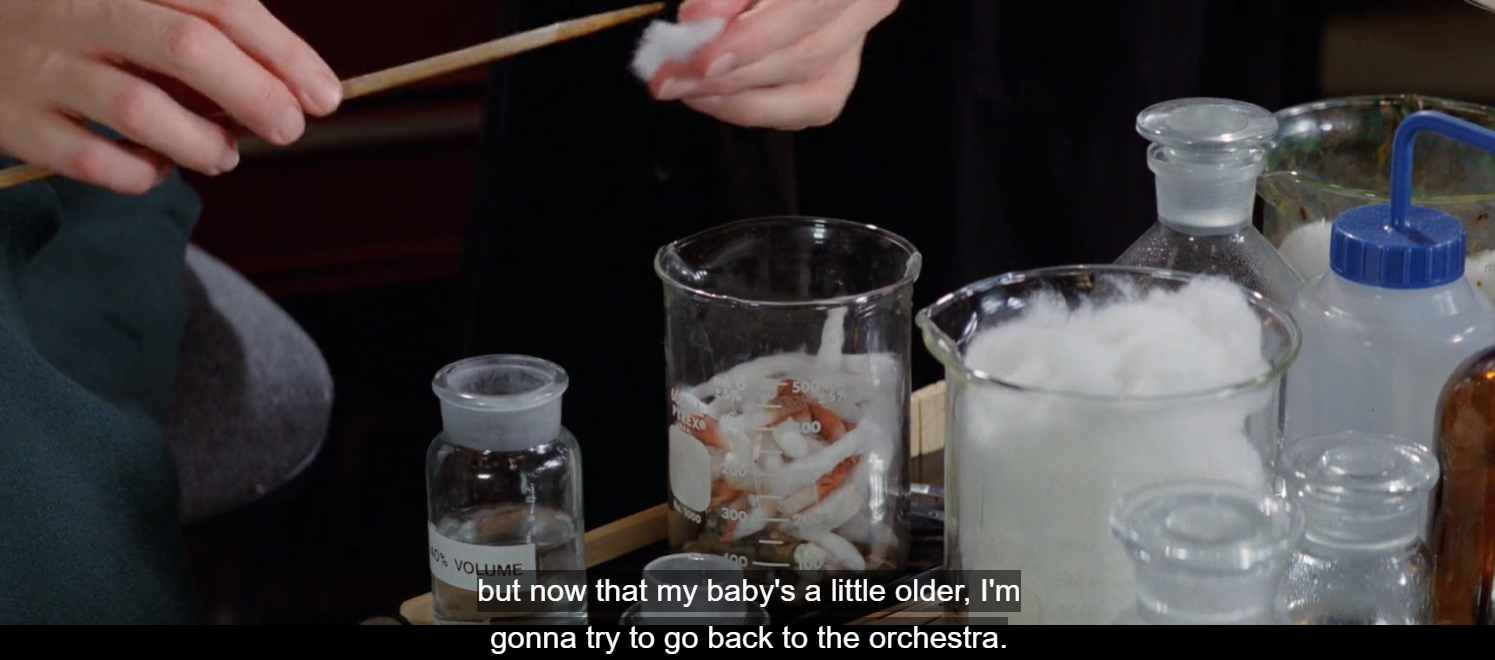
Dana Barrett (Sigourney Weaver) has also had a major life transformation between the two films. It is revealed that she has had a baby and has left her job at the symphony to work as a paintings conservator for the “Manhattan Museum of Art” (filmed in the National Museum of the American Indian, based in the U.S. Customs House in Bowling Green, Manhattan). What’s most impressive is that in the five years between the two movies, she retrained as a paintings conservator, or at least, gained enough experience to be a technician. This is not unbelievable, but impressive. It is funny, however, that she does admit that now that her son, Oscar, is a bit older, she is going to return to the symphony, determining that it pays better (a sad, but probably true statement).
There’s a lot going for the scenes at the museum in this movie. I love the workspace they’re in, despite how unrealistic it is. I want to work in a space with fancy marble floors and stained glass windows, where my colleague wears a bowtie every day. The painting Barrett treats in this scene (removing a nasty-looking orange varnish) is Gauguin’s Still Life with Onions, Beetroot, and Japanese Print, which is in the Metropolitan Museum of Art’s collection, used as the setting in the original script (Aykroyd and Ramis, 1988). I am impressed with the set dressing and background acting in these scenes in particular. Someone in the background of one of the scenes uses a lovely-looking pillow to stabilise the object they’re working on, and some nice lights with magnifiers. There’s even a fume hood with labelled chemical storage in one scene! I appreciate the hand-rolled swabs that Barrett uses and that all of her solvents are labelled. I’m also a sucker for representations that use an optivisor.

The scenes are not perfect, of course, which is what knocks Barrett’s score down. Although a fume hood is visible in the background, there is no extraction system in place where the work is actually being done. Similar to what happened with Scream of the Banshee, the inhalation of solvents may contribute at least in part to the events of the film. There’s also no concept of keeping coffee and food away from the art, making ghosts not the only pests that we should be concerned about. The head conservator(?) Dr Janosz Poha (Peter MacNicol) is also just strange beyond his role in the main plot. To start, as he does his rounds in the lab space, he says, “I want you to know that everything you’re doing is bad; I just want you to know”, but he just lets her continue, without concern for the piece being worked on. I understand this is for comedic effect, but won’t someone think about the art? He also ends up cleaning the central painting strangely. Sometimes he’s standing very far away from it; at one point, he has a ladder up on one side, but proceeds to reach across the entire painting to brush the other side. This can be not only hazardous to the art, but also to personal safety.
This movie does leave us with an excellent quote from Poha: “We don’t go around altering valuable artwork, Dr Venkman”, which I think Head over Heels could learn a thing or two from.
A Month in the Country (1987): 8/10
Available on Peacock (Free with ads)

Set in 1920, the film follows the experiences of Tom Birkin (Colin Firth), who has been employed under a bequest to carry out restoration work on a Medieval mural discovered in a church in the small rural community of Oxgodby, Yorkshire. The escape to the idyllic countryside is cathartic for Birkin, haunted by his experiences in World War I. Birkin soon fits into the slow-paced life of the remote village, and over the course of a summer, uncovering a painting begins to lose his trauma-induced stammer and tics.
This was an enjoyable movie, with a relaxing atmosphere that makes me homesick for the Yorkshire countryside (which was a staple during my time in the UK). Whilst I won’t give Birkin full points, it’s an enjoyable experience to watch him even just take a scalpel to some horrible over-painting and the 80s lighting that makes him glow.
There are several scenes where Birkin talks to children from the village about his work, and it is interesting how the movie speaks of how there are no second chances in cleaning, and Birkin quips about how “[He is] not an artist, [he is] a labourer. [He] cleans up after artists,” which I think diminishes his work but is also not entirely incorrect. The movie is also great at presenting information that can be gained whilst conservation is being performed, including the identification of a hair caught in the paint, the recognition of brush strokes and angles, and the differentiation of painters and their styles that made up the whole.
Quid pro Quo (2009): 9/10
Available on Pluto TV (free with ads)

Quid pro Quo follows Isaac Knott (Nick Stahl), a radio producer for New York Public Radio, as he is tasked with working on a story regarding a subculture of able-bodied people who have a desire to be paraplegic. Knott himself is a wheelchair user who lost the use of his legs at age 8 after a car crash. He becomes fascinated with this group and comes into contact with Fiona Ankany (Vera Farmiga), a “freelance conservator working on a collection for the Van Platt Museum” (a fake museum that is represented by the Brooklyn Museum of Art), who identifies with the “transabled” community.
Fiona is an EXCELLENT conservator overall. I’d argue that the problems I acknowledge here have more to do with the management of the museum in the movie than with her prowess in her field. However, this review is solely focused on her work as a conservator and does not reflect feelings regarding the character herself. The movie is thought-provoking and interesting, though the twist is obvious almost from the very beginning.
Knott visits Ankany at work several times during the course of the film, and she is found working in a storeroom (odd and less than ideal, with seemingly no ventilation for solvents) on several ancient Chinese objects. Her work table demonstrates the tools of a typical conservator, including a scalpel, swabs, solvents in small, brown glass containers, and a good light source. Ankany is also the only conservator I have seen during this review to wear nitrile gloves, which pair well with her lab coat and optivisor. I do have several complaints; of course, no movie is perfect. As I mentioned, she is working in what appears to be a storeroom at the museum, which is not proper procedure, both regarding health and safety and the care of collections. Furthermore, Knott easily accesses this space without supervision by telling security, “It’s a surprise”, which would make me incredibly nervous in real life. Ankany also enjoys watching Knott stumble around the storeroom and around open objects, where he even grabs her table and rattles objects, causing me to hold my breath.
After watching so many bad movies with even worse professional conservation practice, these scenes were a breath of fresh air that almost made up for how disturbing the plot of this movie is.
Honourable Mention: The Monuments Men
Available on Starz and DirectTV

I think I would be remiss if I did not recognise The Monuments Men in this article. It does not have any on-screen conservation scenes (I do not recognise the introduction scene for Matt Damon as a conservation scene), though I would argue that the emergency response is good to highlight in its own right. Of course, they still use cotton gloves, but I will forgive them due to the time period portrayed and the nature of the work performed; cotton gloves are better than no gloves.

However, this film deserves recognition for focusing on a real-life conservator (Morrison, 2014). George Clooney plays Frank Stokes who is largely based on George Stout an American art conservation specialist and museum director who is noted to be the founder of the first conservation laboratory in the United States, as well as for starting the first journal on the subject of art conservation.
I admit that this movie has had a special place in my heart since it came out, and it makes me cry every time. It is an excellent representation of a part of World War II that is rarely considered, despite the Western perception of the importance of European art and institutions (seen more recently in both the Notre Dame fires and the large-scale efforts to protect Ukrainian heritage).
Conclusion
There remains something special about seeing your profession represented in movies. It allows it to feel more “real” to those who have never encountered it before. This, however, remains a double-edged sword. If the depictions offered are the likes of Head over Heels or Scream of the Banshee, then you struggle to escape the image that is created of you and your job (think Indiana Jones and archaeologists). In general, I would love for more fictional films to present conservation (ideally correctly), so that more people can experience its magic and understand why it’s necessary in the world of museums and private collections.
References
A Month in the Country. (1987). Columbia-Cannon-Warner Distributors.
Aykroyd, Dan & Ramis, Harold (1988). Ghostbusters II (August 5, 1988 Draft) (Script p. 2). Via https://ghostbusters.fandom.com/wiki/Manhattan_Museum_of_Art#cite_note-14
Ghostbusters II. (1989). Columbia Pictures.
Haden, T 2025. Behind the Scenes with the Flesh-Eating Beetles Preparing Museum Specimens. Natural History Museum LA County, Natural History Museum Los Angeles County, <https://nhm.org/stories/behind-scenes-flesh-eating-beetles-preparing-museum-specimens>.
Head Over Heels. (2001). Universal Pictures.
Home for the Holidays. (1995). Paramount Pictures.
Made of Honor. (2008). Sony Pictures.
Morrison, J. (2014). The True Story of the Monuments Men. [online] Smithsonian. Available at: https://www.smithsonianmag.com/history/true-story-monuments-men-180949569/.
National Treasure. (2004). Buena Vista Pictures.
National Treasure: Book of Secrets. (2007). Walt Disney Studios Motion Pictures.
Quid Pro Quo. (2009). Magnolia Pictures.
Scream of the Banshee. (2011). SyFy.
The Monuments Men. (2014). Sony Pictures Releasing.
The Relic. (1997). Paramount Pictures.